
Rotator Cuff Injuries
"When Your Shoulder Calls for a Timeout!"
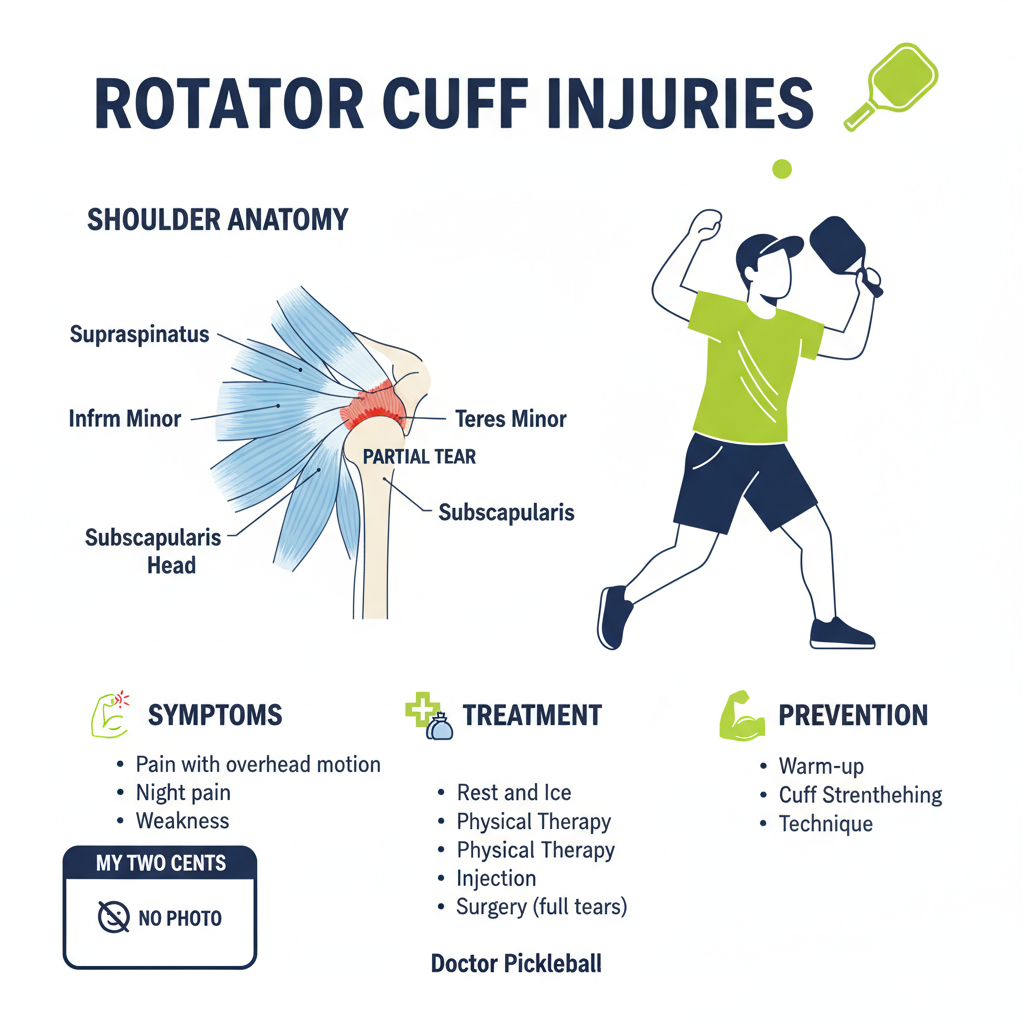
Few things spoil a good rally faster than a shoulder that suddenly refuses to cooperate with your overhead smash.
As an orthopedic surgeon, I can tell you that the rotator cuff is one of the most frequent troublemakers I evaluate in active adults — on and off the pickleball court.
The good news? Most rotator cuff problems respond well to sensible treatment, a little patience, and a well-chosen exercise program.
What's going on?
The rotator cuff is a group of four muscles and their tendons — the supraspinatus, infraspinatus, teres minor, and subscapularis — that work together to keep the ball of your shoulder joint centered as you move your arm.
When you reach up for an overhead volley, these tendons are doing quiet, coordinated work while the big muscles of your chest and back get all the applause.
Rotator cuff problems occur on a spectrum: tendinitis (an irritated, inflamed tendon), partial tears, and full-thickness tears.
Some tears develop gradually through years of use; others follow a specific injury, a fall, or one awkward swing.
How do you recognize it?
Common symptoms include:
- Pain with overhead activity — serving, smashing, or reaching.
- Pain at night, especially when lying on the affected shoulder.
- Weakness when lifting the arm or rotating the shoulder.
- Aching that lingers after play and gradually worsens.
- Sometimes a catching or grinding sensation with movement.
Symptoms may begin gradually from wear, or suddenly after a fall or an awkward swing. Some rotator cuff tears cause surprisingly few symptoms — which is why the examination matters.
Not every aching shoulder is a rotator cuff problem. Neck conditions, arthritis of the joint, biceps tendon problems, and frozen shoulder can all mimic these symptoms.
What actually works?
Relative rest from aggravating activity, ice, and anti-inflammatory medication as appropriate calm most irritated tendons.
The workhorse of treatment. Strengthening the cuff and the muscles that control the shoulder blade restores balance and frequently relieves symptoms — even when a tear is present.
An injection can settle stubborn inflammation and make therapy more comfortable, though it is usually a bridge rather than a cure.
Reserved for full-thickness tears that fail nonsurgical treatment, or larger acute tears. The goal is restoring a working, pain-free shoulder.
Treatment depends on the type and size of the problem, your age and activity goals, and how the tendon looks and behaves on examination.
What about pickleball?
The overhead smash, the high volley, the hard serve — pickleball loves to ask your shoulder for one more raise of the arm.
That repeated overhead motion loads the rotator cuff. In a well-conditioned shoulder that is usually welcome work. In a cuff that is already irritated or worn, it can turn a nagging ache into a real problem.
Warm up before play, keep the surrounding muscles strong with a simple cuff and shoulder-blade program, and build playing time back gradually after any layoff rather than jumping straight into tournament pace.
Remember, the ball already has holes in it — there's no need to put any in your shoulder!
When should you see a doctor?
Seek evaluation if shoulder pain persists for more than a few weeks despite rest, if you notice progressive weakness, or if night pain regularly disturbs your sleep.
Sudden weakness or inability to raise the arm — particularly after a fall — deserves prompt attention, because an acute tear is best assessed early.
Learn More: A Closer Look at Rotator Cuff Injuries
Diagnosis, risk factors, surgery, recovery, and further reading
How is a rotator cuff injury diagnosed?
The evaluation starts with the history and a careful physical examination — where the pain sits, which movements provoke it, and testing the strength of specific cuff muscles.
X-rays look at the bones. MRI or ultrasound imaging can show the tendons directly, including the location and size of a tear. One important caution: abnormal findings on shoulder imaging are common in people without symptoms, so imaging results need to be matched to your examination, not read in isolation.
Who is more likely to develop it?
The risk of rotator cuff problems increases with age, and they become especially common after 40. Repetitive overhead activity — racquet and throwing sports, certain occupations, painting, or lifting — adds wear. Prior shoulder injury and reduced conditioning can also play a role.
When is surgery considered?
Surgery is generally reserved for full-thickness tears that continue to cause meaningful weakness or pain despite appropriate nonsurgical treatment, and for larger acute tears following a significant injury.
Repairs can be performed arthroscopically or through a small open incision, with the goal of reattaching the tendon to bone. Longstanding, massive tears may not be repairable, in which case other options are considered based on symptoms and goals.
What should you expect after treatment?
For injuries treated without surgery, steady improvement usually builds over weeks to months as strength and motion return.
After surgical repair, expect a period of protected movement followed by a graduated strengthening program. Tendon healing takes time — recovering full strength is more a matter of months than weeks, and the return to the court should follow the shoulder's progress, not the calendar.
Further Reading
- American Academy of Orthopaedic Surgeons (AAOS): Rotator Cuff Tears — OrthoInfo
- National Institute of Arthritis and Musculoskeletal and Skin Diseases (NIAMS): Shoulder Injuries
- Mayo Clinic: Rotator Cuff Injury — Symptoms and Causes
Medical education only. This article is not a substitute for individualized medical evaluation, diagnosis, or treatment.
Medical education only. This article is not a substitute for individualized medical evaluation, diagnosis, or treatment.