
Hyperbaric Oxygen: Can You Pressurize Your Way Back Onto the Pickleball Court?
By Mark C. Engasser, MD — Board-Certified Orthopedic Surgeon
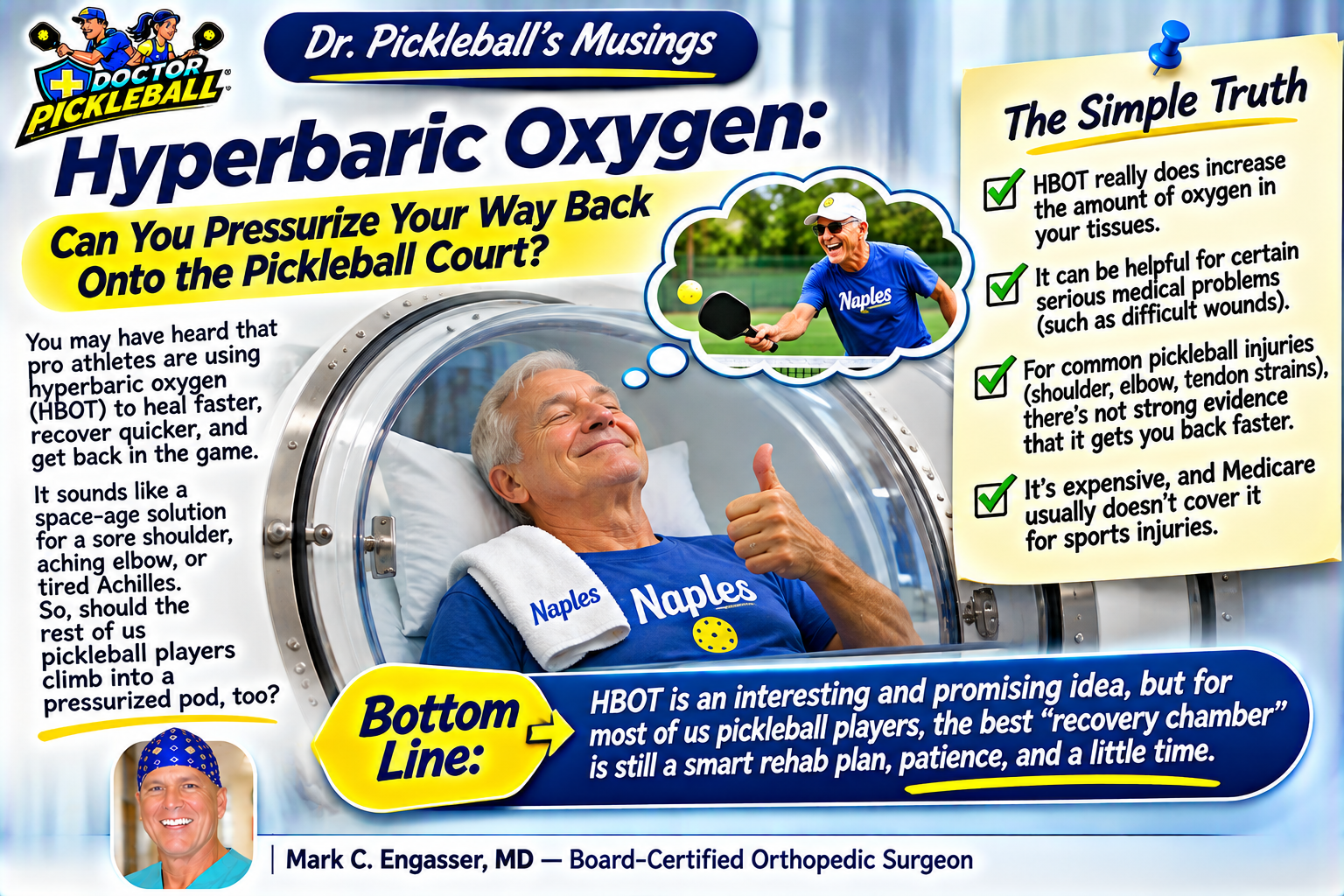
Scroll through the social media feed of almost any professional athlete and, sooner or later, you will spot a curious sight: a grown adult in comfortable clothing, lying inside something that looks like a cross between a submarine and a tanning bed, reading a magazine at twice the normal atmospheric pressure. Welcome to the world of hyperbaric oxygen therapy — or HBOT, if you enjoy acronyms nearly as much as professional athletes enjoy recovery gadgets.
And because everything professional athletes do eventually trickles down to the rest of us — usually at a fraction of the benefit and twice the price — it was only a matter of time before a pickleball player asked me the question: "Doc, would one of those oxygen chamber things get me back on the court faster?"
Great question. Let's take a deep breath — ideally at sea level — and work through it together.
Why Are Professional Athletes Sitting in Giant Scuba Tanks?
Professional athletes will try almost anything legal to recover faster. Their careers are short, their paychecks are enormous, and even a tiny edge can be worth millions. So when a recovery chamber promises faster healing, team trainers and team accountants both take notice.
Some professional teams own or rent hyperbaric chambers, and plenty of individual athletes swear by them. When a millionaire pitcher tells you the chamber changed his life, believe that he believes it. But remember what a testimonial is: an anecdote with better marketing. Anecdotes are wonderful for selling chambers and considerably less reliable for measuring healing.
How Does the Treatment Actually Work?
Under normal conditions, your lungs pull oxygen out of the air at sea-level pressure and hand it to your red blood cells, which deliver it around your body like a highly efficient delivery fleet.
In a hyperbaric chamber, two things change. The air pressure is raised to roughly two to three times normal, and you breathe pure oxygen rather than the everyday 21-percent blend. Under higher pressure, more oxygen dissolves directly into the liquid portion of your blood — the same physics that keeps a sealed soda can fizzing quietly until you open it.
A typical session lasts an hour or two, and meaningful protocols usually involve many sessions. For certain well-established medical uses — decompression sickness in divers, carbon monoxide poisoning, certain stubborn wounds that refuse to heal, and injuries from radiation therapy — hyperbaric oxygen is genuine, guideline-supported medicine. Nobody disputes that.
What Does the Evidence Say About Pickleball Injuries?
Here is where the court gets slippery. For the problems that actually send pickleball players to my office — tennis elbow, golfer's elbow, rotator cuff irritation, Achilles tendinopathy, and ordinary muscle strains — the evidence for hyperbaric oxygen is thin. Studies tend to be small, results are mixed, and there is no strong proof that it speeds recovery of routine sports injuries.
Tendons heal on their own unhurried schedule, and there is no good evidence that a bit of extra dissolved oxygen persuades an overused tendon to hurry. If pressurized oxygen dramatically fixed tendon injuries, orthopedic surgeons would be prescribing it constantly, and waiting rooms would look like submarine requisition lines.
Why Medicare Generally Says No
Medicare covers hyperbaric oxygen therapy only for a specific list of approved conditions — wound and emergency problems, not routine sports injuries.
Medicare is many things — punctual is not one of them, and generous is open to debate — but it is not easily fooled by a trendy treatment. Its coverage list is built on evidence that a treatment works for a condition. Routine sports injuries did not make the list.
That is worth more than any brochure. When a treatment's advocates charge a premium and Medicare declines to pay for it outside a narrow list of conditions, the reason is usually not paperwork. It is evidence — or the lack of it.
The Cost — and the Risks
Then there is the matter of money. Sessions at outpatient centers commonly run well over a hundred dollars each, sometimes several hundred, and a real protocol means many visits. A full course can add up to the price of a very nice paddle — or several — with considerably less evidence behind it.
The risks are real, if usually manageable:
- Ear or sinus pressure discomfort — the chamber feels a bit like a very long airplane descent that you cannot ask the pilot to end.
- Temporary changes in vision, which typically resolve after treatment.
- Claustrophobia — the chambers are roomier than they look on television, but not roomy in the way a pickleball court is roomy.
- Rare but serious risks, including seizures from oxygen toxicity — one reason treatment is medically supervised.
- Strict fire-safety rules, because a chamber full of pure oxygen and a spark are terrible dance partners. If you smoke, the chamber is not your venue.
None of this makes hyperbaric oxygen dangerous quackery — for approved uses it is legitimate medicine. But "the risks are manageable" and "the risks are worth it" are two different sentences, and the second one needs evidence.
So What Should You Actually Do?
For a routine pickleball injury, conventional rehabilitation remains the sensible first choice: a proper diagnosis, physical therapy, progressive strengthening, sensible activity modification, time, and — I realize this is the hardest ingredient for pickleball players — actual rest for the injured part.
Hyperbaric oxygen is not the first rung on that ladder, and for most sports injuries it is not on the ladder at all. If you remain curious, ask your physician whether your specific problem has any evidence behind it, and whether your specific situation makes it reasonable. Some patients do have circumstances where it deserves a conversation.
The good news is that getting back on the court does not require a pressurized capsule. It requires a plan, a little patience, and the willingness to let your body do the healing it already knows how to do. Your tendons have been doing this job for decades — they have simply been waiting for you to give them a fair chance.
Now, if you'll excuse me, I have a court reservation — at a perfectly normal one atmosphere.
This article is for general education and is not a substitute for individual medical advice. Talk with your own physician about your specific situation before starting, stopping, or paying for any treatment.