
To Repair, Replace, or Reverse? That Is the Shoulder Question!
When your rotator cuff calls it quits, should you stitch it, switch it, or reverse it?
By Mark C. Engasser, MD · Board-Certified Orthopedic Surgeon · Doctor Pickleball
When Your Shoulder Has More Miles Than Your Car
As we get older, many of us take pride in remaining active.
We play pickleball, golf, tennis, swim, lift weights, and occasionally attempt activities our grandchildren think we should have abandoned years ago.
Unfortunately, our shoulders don't always share our enthusiasm.
One day, that overhead smash feels great. The next, reaching into the cupboard becomes a challenge.
An MRI reveals a rotator cuff tear.
Now comes the question:
Should I repair the tendon, replace the shoulder, or reverse the shoulder replacement?
The answer isn't as simple as your age, the size of the tear, or what the MRI report says.
And here's something that surprises many patients: sometimes the smallest operation requires the longest recovery.
First, Not Every Rotator Cuff Tear Needs Surgery
Rotator cuff tears become increasingly common with age.
Some occur suddenly following an injury. Others develop gradually as the tendons weaken and degenerate.
Many older adults have rotator cuff tears without significant pain or disability.
In fact, finding a tear on an MRI doesn't necessarily mean you've found the cause of someone's shoulder pain.
We treat patients, not MRI scans.
For many senior athletes, physical therapy, strengthening of the remaining functional muscles, activity modification, and appropriate pain management can provide meaningful improvement.
The important questions are:
- How much pain are you experiencing?
- Is there genuine weakness or loss of function?
- Was the tear caused by a recent injury?
- How large is the tear, and is the tendon repairable?
- Is there significant muscle atrophy or fatty degeneration?
- Is the shoulder joint itself arthritic?
- What activities do you want to return to?
And perhaps most importantly, what happens if we don't operate?
Sometimes the best surgical decision is not to operate at all.
Option One: Repair the Rotator Cuff
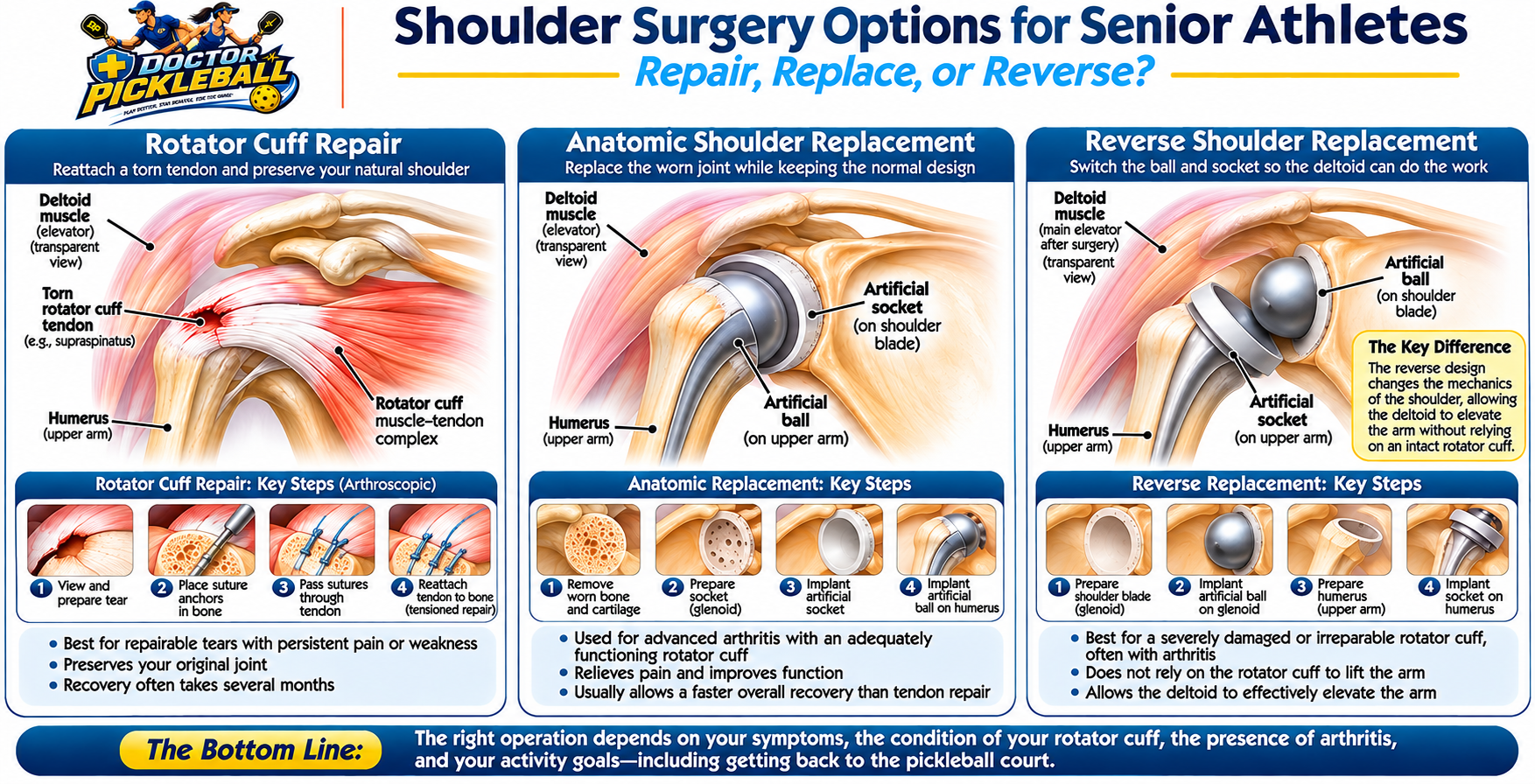
When a torn tendon is still repairable, particularly following a recent injury or in an active patient with persistent symptoms, rotator cuff repair may be appropriate.
The goal is to reattach the tendon to the bone and preserve the patient's natural shoulder joint.
Modern arthroscopic techniques allow surgeons to perform many repairs through small incisions using sutures and anchors.
Sounds simple enough.
But here's the catch.
The operation may be relatively small. The rehabilitation isn't.
A repaired rotator cuff must biologically heal back to bone.
That process takes months.
Depending on the tear and repair, patients may spend several weeks in a sling, followed by carefully staged rehabilitation.
Return to strenuous overhead activities often takes six months or longer.
And yes, recovery can be surprisingly uncomfortable and frustrating.
Some patients undergoing shoulder replacement experience earlier pain relief and functional improvement than patients undergoing rotator cuff repair.
That doesn't mean every replacement is easier or less painful. But it does mean that arthroscopic surgery isn't automatically a shortcut back to the pickleball court.
Unfortunately, your rotator cuff doesn't care that your mixed doubles partner needs you next Tuesday.
What About Repairing the Rotator Cuff in Someone Over 70?
Age alone should not determine whether a rotator cuff is repairable.
A healthy, active 75-year-old with good tendon quality, limited muscle degeneration, and a repairable tear may be a reasonable surgical candidate.
On the other hand, a 60-year-old with a massive chronic tear, severe tendon retraction, and substantial fatty muscle degeneration may have a much less favorable prognosis.
The biological age and condition of the tendon can matter more than the age on your driver's license.
However, larger chronic tears in older adults have higher rates of structural failure after repair.
And here's an interesting point: some patients experience meaningful pain relief and improved function even when postoperative imaging shows incomplete tendon healing.
A perfect MRI isn't always necessary for a satisfied patient.
Understanding the Three Operations
Option Two: Anatomic Shoulder Replacement
Now suppose the problem isn't simply a torn tendon.
Suppose the shoulder joint itself has significant arthritis.
The cartilage has deteriorated, the joint is painful and stiff, and conservative treatment hasn't provided sufficient relief.
An anatomic total shoulder replacement may be appropriate.
In this operation, the surgeon replaces the arthritic ball and socket while preserving their normal arrangement.
But there's an important requirement.
An anatomic shoulder replacement generally needs an adequately functioning rotator cuff.
Why?
Because the rotator cuff helps center and stabilize the humeral head while the deltoid supplies much of the force needed to elevate the arm.
A Painless Shoulder Isn't Necessarily a Functional Shoulder
Imagine having shoulder replacement surgery and eventually achieving a relatively painless shoulder.
Sounds wonderful, doesn't it?
But now imagine that despite having little or no pain, you still can't raise your arm high enough to reach into a cupboard, comb your hair, or hit an overhead pickleball shot.
You've relieved the pain, but you haven't restored the function.
And that's a major concern when considering an anatomic shoulder replacement in someone with a severely damaged or inadequate rotator cuff.
An anatomic replacement reproduces the normal ball-and-socket arrangement. But it still depends on the rotator cuff to stabilize and center the humeral head while the deltoid elevates the arm.
If the rotator cuff is severely deficient, the artificial humeral head may migrate upward, the shoulder may lose its normal mechanics, and the patient may have difficulty actively elevating the arm.
Over time, abnormal loading can also threaten the replacement's durability.
In other words, simply replacing the worn-out joint surfaces doesn't necessarily solve the underlying mechanical problem.
A new ball and socket cannot substitute for a missing rotator cuff.
A small or repairable rotator cuff tear doesn't necessarily rule out an anatomic replacement.
But a massive, irreparable tear can change the entire surgical plan.
And that's precisely the problem reverse shoulder replacement was designed to address.
Option Three: Reverse Shoulder Replacement
Now we come to one of the most fascinating innovations in modern orthopedic surgery.
What if the rotator cuff is so badly damaged that repairing it is unlikely to succeed?
And what if the patient also has significant arthritis—or such profound weakness that ordinary daily activities have become difficult?
Enter the reverse total shoulder replacement.
Dr. Pickleball's Perspective: Two Shoulders, Two Operations, Two Great Results!
I've spent much of my professional life evaluating orthopedic problems, but when it comes to shoulder surgery, I've also experienced things from the patient's side of the operating table.
I've had an anatomic total shoulder replacement on my dominant left shoulder and an arthroscopic rotator cuff repair on my once nearly useless right shoulder.
And I'm delighted to report excellent results from both!
Two different shoulders. Two different problems. Two different operations.
And two very successful outcomes.
My experience reinforces something I've always believed: the best operation is the one that addresses the particular problem in that particular shoulder.
Of course, my results don't guarantee the same outcome for everyone. But I'm certainly grateful for mine.
And to the surgeons who helped get me back to doing the things I enjoy:
Thank you, doctors—the best shoulder surgeons in the world!
At least from where I'm standing at the pickleball kitchen line!
— Dr. Pickleball
This article is for general education and is not a substitute for individual medical advice.