
The Knee Bone's Connected to the Belly Bone!
Could a Shot in the Belly Save You From a New Knee?
By Mark C. Engasser, MD
A Final Thought on Veterans Day — Before We Get Back to Pickleball and Aching Knees
I've received a wonderful amount of feedback following my Veterans Day tribute, including personal stories from those who served and from families whose loved ones served our country.
I sincerely appreciate everyone who took the time to share these experiences. Many of these stories remind me of my own father and a generation that quietly served, sacrificed, and rarely sought recognition.
My hope is that we remember these heroes not just on Veterans Day, but throughout the year.
And perhaps the best way to honor them is to follow their example in our own lives through three simple values:
Honor. Honesty. Humility.
Do what's right, take responsibility, serve others, and don't feel compelled to tell the world how wonderful you are.
As the saying goes, “Act like you've been there before.”
Thank you again for sharing your stories. Please keep them coming.
And now, speaking of those who have carried a heavy load, let's talk about our knees!
Dr. Pickleball
Today's Musing opens with a final Veterans Day thought — a follow-up to "A Veterans Day Salute".
For most of my orthopedic career, when a patient came into my office complaining of knee arthritis, I had a fairly predictable conversation.
“Your X-rays show arthritis. You've lost some cartilage. We can try exercise, physical therapy, anti-inflammatory medications, injections, perhaps a knee brace, and eventually, if all else fails, a knee replacement.”
And somewhere in that discussion, I would gently mention that losing a few pounds might help.
That suggestion was usually received with approximately the same enthusiasm as telling a pickleball player that his foot was in the kitchen.
But now, something rather remarkable is happening.
We have medications originally developed for diabetes and obesity that are producing substantial weight loss and, perhaps just as importantly, significant relief from knee arthritis pain.
And the best part?
The orthopedic surgeon doesn't even have to sharpen his instruments!
Well, perhaps we shouldn't cancel the operating room schedule just yet.
First, Let's Discuss the Elephant in the Room
Or, more appropriately, the elephant sitting on your knee.
Here's something that may surprise you.
For every pound of body weight you lose, you can reduce the load on your knee by approximately FOUR pounds with each step you take.
That's right. Four pounds!
A frequently cited study published in Arthritis & Rheumatism in 2005 found that overweight and obese older adults with knee osteoarthritis experienced approximately four pounds less knee-joint loading per step during walking for every pound of body weight they lost.
Lose 10 pounds, and your knee may experience approximately 40 pounds less load with each step.
Lose 25 pounds, and we're talking about roughly 100 pounds less load per step.
Now imagine walking 5,000 steps a day.
Your knees may feel as though they've been released from carrying a small refrigerator around Naples.
And for my fellow pickleball players, consider all the running, stopping, lunging, and chasing those impossible drop shots.
The forces across your knees during some of these activities can be considerably greater than during ordinary walking.
Of course, the four-to-one relationship is an approximate research finding, not a universal formula for every person or activity. It describes dynamic knee loading during walking, not simply the pressure on your knee while standing.
But the message is unmistakable.
Your knees don't care how good you look in your pickleball shorts. They care how much weight they're carrying!
And unfortunately, buying a $300 paddle doesn't make you 10 pounds lighter.
I've checked.
Enter Semaglutide: The Belly Shot That Helped the Knee
In 2024, researchers published an important study in the New England Journal of Medicine involving 407 patients with obesity and painful knee osteoarthritis.
Participants received either weekly semaglutide injections or placebo, along with counseling about diet and exercise.
After 68 weeks, the results were impressive.
Patients receiving semaglutide lost an average of approximately 13.7% of their body weight, compared with 3.2% in the placebo group.
Their knee pain improved substantially more as well.
On a 100-point arthritis pain scale, the semaglutide group improved by approximately 42 points, compared with 28 points in the placebo group.
Physical function improved, too.
In other words, these patients weren't simply becoming lighter.
They were becoming more comfortable and more mobile.
For someone who has spent decades looking at arthritic knees, that is significant.
We are not talking about growing new cartilage or magically restoring a worn-out joint.
We are talking about making an arthritic knee considerably less painful without operating on it.
And that is worth paying attention to.
Then Along Comes Retatrutide: Apparently Two Hormones Weren't Enough
Just when we were getting comfortable pronouncing semaglutide, along came retatrutide.
Frankly, pharmaceutical companies could do us all a favor and name these medications something simple.
How about Knee-Be-Gone?
Retatrutide is an investigational medication that acts on three different hormone receptors involved in appetite and metabolism.
Semaglutide targets one.
Tirzepatide targets two.
Retatrutide targets three.
Apparently, this is becoming a competition to see how many receptors we can stimulate before the average physician needs a flowchart.
In the 2026 clinical research, patients receiving retatrutide experienced very substantial weight loss and significant improvement in knee arthritis pain.
In one treatment group, average weight loss approached 24% over 68 weeks.
Think about that.
For a 250-pound individual, that represents nearly 60 pounds.
That's approximately the weight of a large bag of dog food, a small child, or the collection of unnecessary items my wife insists I remove from the garage.
Imagine carrying that extra weight around every day.
Then imagine putting it down.
Your knees might send you a thank-you card.
Importantly, retatrutide remains investigational, and its results should not be interpreted as proof that it is superior to semaglutide for treating arthritis. The studies were not direct comparisons.
But Wait! Are We Actually Treating Arthritis?
Here is where things become particularly interesting.
We know that reducing weight decreases mechanical stress on the knee.
But could these medications also reduce inflammation?
Possibly.
Researchers are investigating whether GLP-1-based therapies have biological effects that go beyond weight loss, including effects on inflammatory pathways and joint tissues.
That would be exciting.
However, we need to distinguish between what we know and what we hope.
What we know: These medications can substantially reduce knee pain in appropriately selected patients with obesity.
What we don't know: Whether they can reliably prevent cartilage deterioration, regenerate damaged cartilage, or eliminate the eventual need for joint replacement.
An arthritic knee that stops hurting is not necessarily a knee that has stopped being arthritic.
As I often reminded patients, an X-ray doesn't hurt.
The patient does.
And sometimes the X-ray looks terrible while the patient is doing just fine.
Other times, the X-ray looks relatively modest, but the patient walks into the office as though he just completed a 26-mile marathon wearing ski boots.
Orthopedic medicine has always been about treating the patient, not simply the picture.
“Bone on Bone!” — Three Words That Can Scare the Pants Off a Patient
Over my decades of orthopedic practice, I've heard countless patients announce, often with considerable alarm:
“Doctor, I've been told my knee is BONE ON BONE!”
They usually say this in the same tone someone might use to announce that their house is on fire.
And frequently, the next question is:
“So, when do I need my knee replaced?”
Well, not so fast!
The ends of the bones in a healthy knee are covered with smooth articular cartilage. This cartilage allows the joint surfaces to glide over one another with remarkably little friction.
With osteoarthritis, that cartilage gradually deteriorates.
As the cartilage becomes thinner, the space between the bones on an X-ray becomes narrower.
In advanced arthritis, the cartilage may become so worn that the joint space appears completely gone.
That's what we commonly call bone on bone.
And yes, in some areas of the joint, the protective cartilage may truly be absent, allowing exposed bone surfaces to contact one another.
Sounds terrible, doesn't it?
You would think the patient should immediately be wheeled into the operating room.
But here's the surprising part: Bone on bone does NOT automatically mean you need a knee replacement.
Your X-Ray Doesn't Feel Pain. You Do!
One of the most fascinating things about orthopedic medicine is how poorly X-ray findings sometimes correlate with symptoms.
I've seen patients with absolutely dreadful-looking knees on X-rays who walk into the office smiling, play golf three times a week, and have very little discomfort.
Then I've seen patients whose X-rays show relatively modest arthritis who can barely walk across the parking lot.
How can that be?
Because pain is complicated.
Cartilage itself has no pain nerves. But the bone beneath it, the joint lining, ligaments, surrounding muscles, and other structures certainly can contribute to pain.
Inflammation, swelling, bone marrow changes, joint mechanics, muscle strength, and individual pain sensitivity all influence how a knee feels.
The severity of arthritis on an X-ray is not necessarily the severity of the patient's disability.
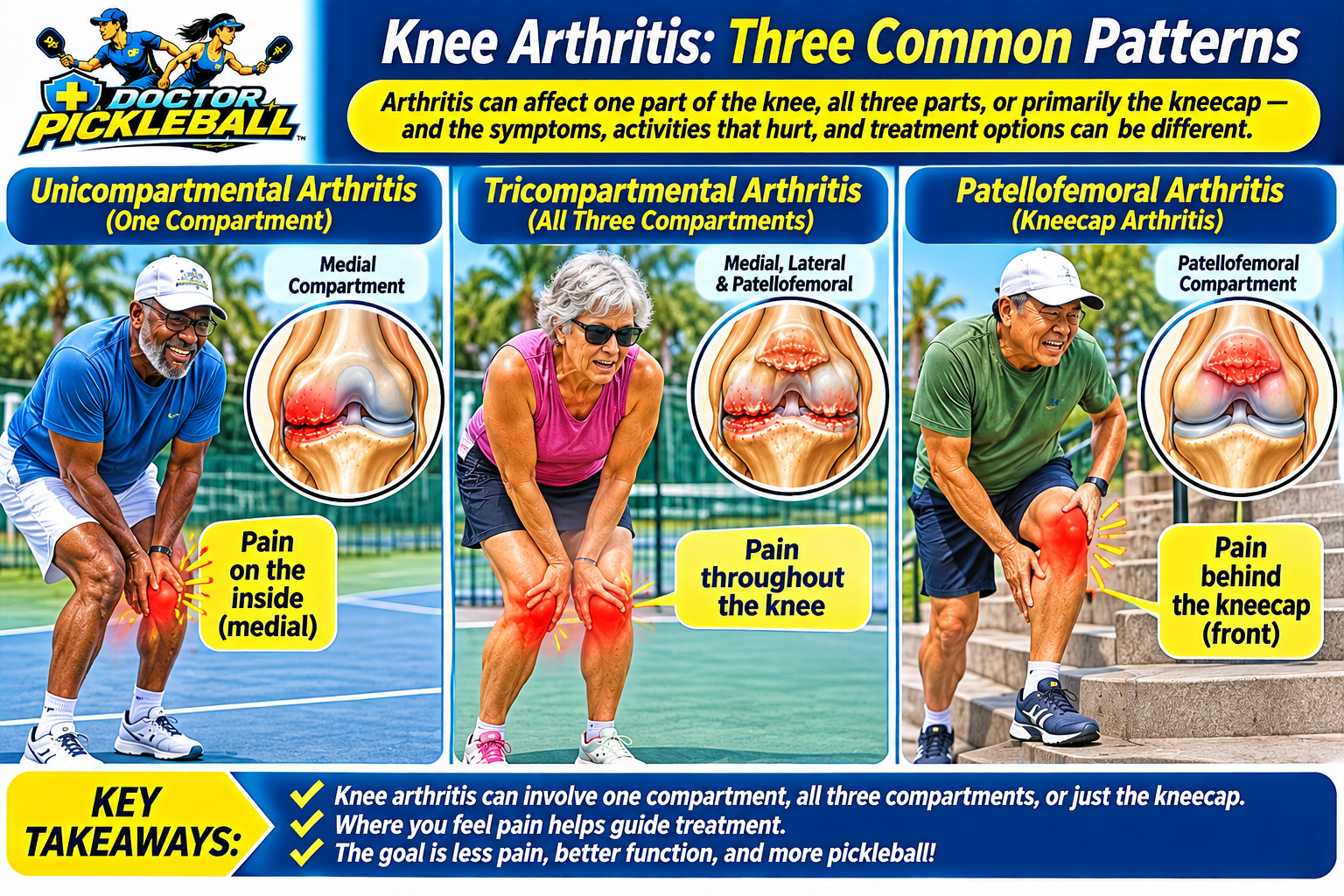
Don't Forget the Kneecap!
The knee actually has three major compartments.
The medial compartment is on the inside, the lateral compartment is on the outside, and the patellofemoral compartment is the joint between the kneecap and the femur.
And that third compartment deserves some attention.
The kneecap isn't simply a decorative bone sitting on the front of your knee.
It plays an important role in the quadriceps mechanism, improving the mechanical efficiency of knee extension.
The underside of the kneecap is covered with cartilage and moves within a groove in the femur as the knee bends and straightens.
This is the patellofemoral joint.
And it can develop arthritis just like the medial and lateral compartments.
Patients with patellofemoral arthritis frequently complain of pain when climbing or descending stairs, getting out of a chair, squatting, or kneeling.
Some describe grinding, crunching, or a sensation that their kneecap is moving over a gravel road.
In medical terminology, we call this crepitus.
In pickleball terminology, we call it the sound of getting older.
Patients may walk comfortably on level ground but experience considerable discomfort when climbing stairs or bending deeply.
And sometimes the kneecap seems to be saying:
“Listen, buddy, we're 75 years old. Could you possibly hit the ball a little higher?”
Unloading Knee Braces: Great Engineering, but Will You Actually Wear One?
For selected patients with arthritis predominantly affecting one side of the knee, an unloading brace may provide meaningful relief.
Medial compartment arthritis commonly occurs with bowlegged, or varus, alignment. A valgus-producing brace can reduce loading on the inside of the knee.
Lateral compartment arthritis may occur with knock-kneed, or valgus, alignment. A varus-producing brace may reduce loading on the outside.
But there is one enormous catch.
The brace has to fit properly, be comfortable, and actually be worn.
These braces can slip, rub, pinch, or become uncomfortable during activity.
I've seen sophisticated braces that look wonderful in the orthopedic office but become miserable after a few hundred yards of walking.
Suddenly, that marvelous piece of engineering feels like you've strapped a lawn mower to your leg.
My advice: Don't buy an unloading brace unless it fits properly and is comfortable enough that you will actually wear it.
Have it professionally fitted and adjusted. Try walking, sitting, bending, and performing normal activities before committing to it.
A brace sitting in your closet has approximately the same therapeutic value as the exercise bicycle gathering dust in your garage.
Zero.
What About Arthritis Behind the Kneecap?
Conventional medial and lateral unloading braces are designed primarily to redistribute forces between the tibiofemoral compartments.
They are not specifically designed to unload the kneecap.
For patellofemoral arthritis, treatment may include physical therapy, quadriceps and hip strengthening, activity modification, taping, and sometimes patellar-stabilizing braces.

When Is Knee Replacement Appropriate?
Here's something I emphasized throughout my orthopedic career:
We treat the patient, not the X-ray.
I've seen patients with bone-on-bone arthritis who remain active, comfortable, and perfectly happy playing golf or pickleball.
I've also seen patients with less impressive X-rays who experience significant pain and disability.
An X-ray doesn't feel pain. The patient does.
The decision to replace a knee depends on symptoms, function, examination, imaging, previous treatment, and the patient's goals.
If you're comfortably playing pickleball, walking the beach, and enjoying your grandchildren, why rush to replace your knee simply because the X-ray looks terrible?
But if pain interferes with walking, sleep, everyday activities, and quality of life despite appropriate nonsurgical treatment, knee replacement may be an excellent option.
For carefully selected patients with arthritis confined to one compartment, partial knee replacement may also be appropriate.
The goal is the right treatment for the right patient at the right time.
Preserving Muscle While Losing Weight
There is an important warning for older pickleball players considering substantial weight loss.
You can lose muscle along with fat.
And muscle is particularly valuable as we age.
Strong quadriceps, hamstrings, gluteal muscles, and core muscles help support the knees, preserve balance, and maintain mobility.
Losing 40 pounds may be wonderful.
Losing 40 pounds while becoming too weak to get out of a chair is considerably less wonderful.
That's why resistance training, adequate protein, and monitoring strength are important during substantial weight loss, particularly when using weight-management medications.
I'd rather see a 75-year-old pickleball player carrying a few extra pounds but possessing excellent strength than a thinner player who looks terrific in his new shorts but can't reach a drop shot.
The goal isn't simply to live longer. It's to remain functional enough to enjoy living longer.
And preferably to keep beating your grandchildren at pickleball.
At least until they turn 12.
Dr. Engasser's Perspective: The Orthopedic Surgeon May Have to Share the Spotlight
Having practiced orthopedic surgery for decades, I find these developments fascinating.
We've made remarkable advances in joint replacement surgery, implants, instrumentation, anesthesia, and rehabilitation.
But perhaps one of the most important developments in treating knee arthritis will come from an entirely different specialty.
Endocrinology.
Who would have guessed?
For years, orthopedic surgeons have been fixing knees from the outside.
Now we're discovering ways to improve how those knees feel by changing what's happening inside the body.
Weight reduction, improved metabolic health, strengthening, and appropriate nonsurgical treatments may allow some patients to remain active without immediately requiring surgery.
But we should not confuse pain relief with cartilage regeneration. These medications aren’t appropriate for everyone, and retatrutide remains investigational.
The best knee replacement is sometimes the one you don’t need—at least not yet.
And remember:
Losing weight may take pressure off your knees. Unfortunately, it won’t improve your line calls.
Some conditions remain beyond the reach of modern medicine.
Scientific References
- Messier SP, et al. Arthritis & Rheumatism, 2005. https://doi.org/10.1002/art.21139
- Bliddal H, et al. New England Journal of Medicine, 2024. https://www.nejm.org/doi/10.1056/NEJMoa2403664
- Retatrutide knee osteoarthritis clinical trial, New England Journal of Medicine, 2026. https://www.nejm.org/doi/full/10.1056/NEJMoa2610676
This article is for general education and is not a substitute for individual medical advice.